
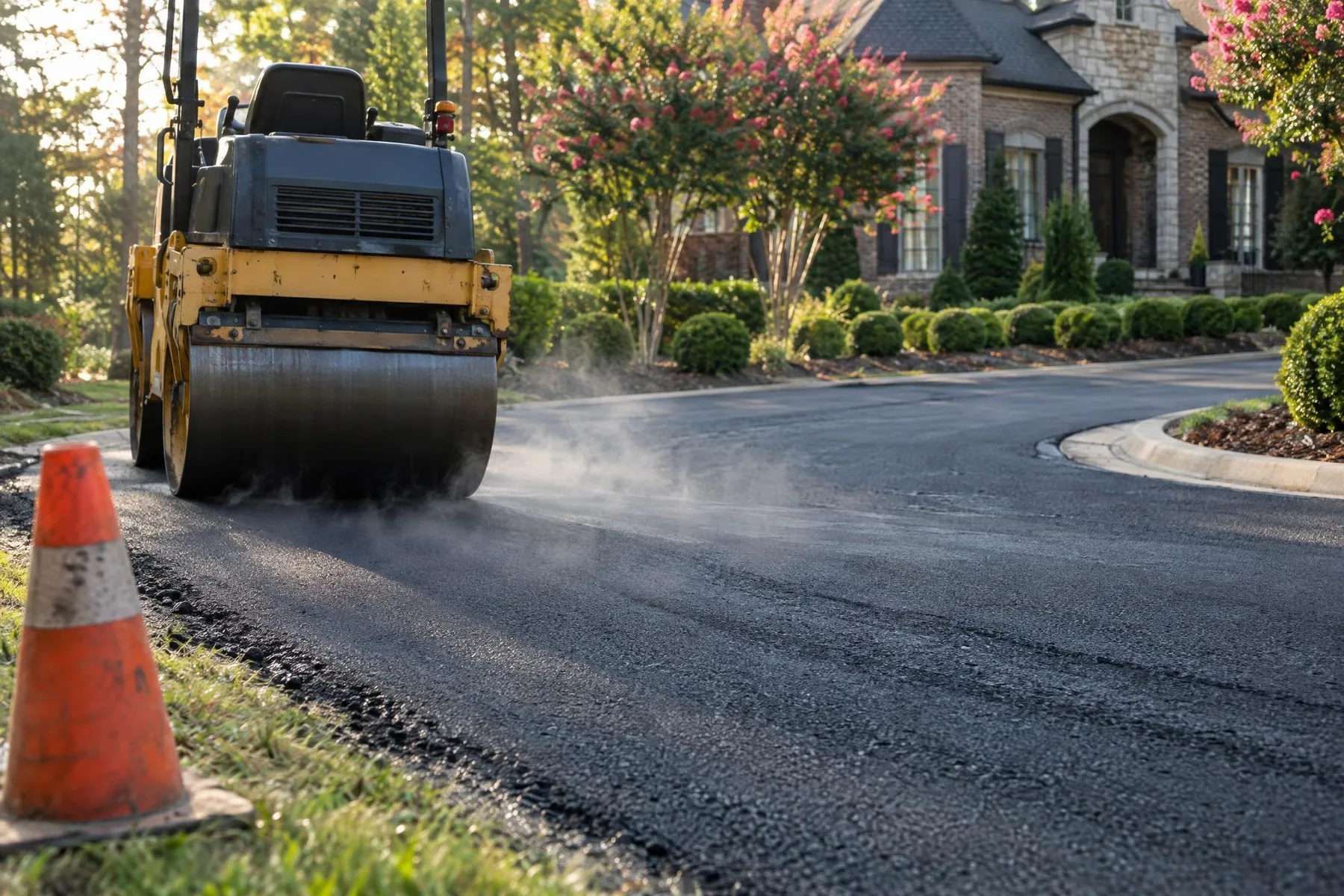
Roller compacting a freshly laid asphalt driveway that curves into a cul-de-sac

How Asphalt Paving Works in Johns Creek, GA: Lifespan and When You Can Drive On New Asphalt

How Asphalt Paving Works on a Johns Creek, GA Driveway or Parking Lot, Step by Step

Johns Creek Asphalt Paving & Repair lays out the whole job for homeowners and HOA boards in Johns Creek, GA and Fulton County. Hardly anyone watches a paving crew from the first shovel to the last roller pass. Here is how asphalt paving works on a driveway, a neighborhood street or an amenity lot, and what each stage means for the years the surface will last.

Why homeowners choose us:

  • Free written estimates for every paving job
  • Compacted base under every new surface, not just a layer of asphalt on top
  • Warrantied work every job backed by a written warranty
  • Licensed and insured certificate on request

The order below was refined over 20+ years of metro Atlanta paving and 1,400+ driveways, lots and roads. Large jobs and small ones run the same way, and the estimate names every stage ahead of time. Only the equipment changes with the size of the property, so an HOA road and a two-car driveway share one plan. Questions are welcome at any point, and the crew answers them on site.

Get a FREE Asphalt Paving Quote

How Asphalt Paving Works: Why Johns Creek Pavement Cracks First

What you see on a driveway is a skin. Underneath, a bed of crushed rock does the heavy lifting, with asphalt of three to five inches resting on rock four to eight inches deep. If water softens that bed, the skin bends under each tire and splits along the stress lines.

Local ground raises the odds. Soil surveys here list Madison, Cecil, Pacolet and Appling soils, many with a clay-rich subsoil of 30 to 47 percent clay, and several streets pitch at 10 to 25 percent. Wet clay has little strength, and slopes push runoff across driveways at speed. A base built without those facts in mind gives out early.

Climate adds to it. Rain totals about 50 inches a year without a dry season, and nearly 36 nights fall to freezing or lower. Moisture enters every opening, freezes and expands, and the crack grows a little with each cold snap. So a good job puts more care below the surface than on top. Owners who understand this tend to ask better questions of every bidder, and they spend less on repairs later.

How Asphalt Paving Works in Five Steps on a Johns Creek Driveway or Parking Lot

The asphalt paving process keeps one fixed order on every job, and this is what you will see from the street.

1. Walk-Through and Soil Probing

Phone the office to set a visit, and the estimator walks the property. Soft ground is tested by foot and by probe, and any place where rain pools or sheets off a slope gets noted. Afterward you receive a free written estimate stating the thickness, the base work and the drainage plan, so the ground holds no surprise on paving day.

2. Tear-Out and Base Work

Crews break out failed asphalt, load it onto trucks and dig away any clay that has gone soft. Crushed rock then goes down in lifts, with a plate or roller pressing each one until the base is firm. On sloped lots, the rock is shaped so water leaves the surface. The base decides how long the pavement lives, which is why this stage takes the most time.

3. Placing the Hot Mix

Where new asphalt will meet old, the crew sprays a thin glue layer so the two bond. Then hot mix is delivered by truck and spread through a paver in a smooth sheet at the depth on your estimate. Workers finish the edges and tight corners by hand. The mix has to be placed hot, so trucks, paver and roller crew move as a single unit.

4. Rolling the Surface

Rollers weighing several tons pass over the mix while it is still warm. That pressure builds density and strength into the pavement. Someone watches the slope as the machines pass, since a dip made now becomes a puddle for years. Seams between passes receive extra attention, because an open seam is where water finds its first way in.

5. Cooling, Cure and Handover

Cones go up around the new surface and stay until the crew clears it for traffic. Together you walk the finished job, talk through sealcoating, and the written warranty is handed over for your file. The pavement keeps hardening for months, so the crew also explains what to avoid early on, such as twisting the wheel while the car sits still.

How Long Does Asphalt Last in Johns Creek, and When Can You Drive on New Asphalt

A driveway on a sound base can serve between fifteen and thirty years, and the middle of that spread is about twenty. A thin overlay delivers less, commonly eight to fifteen years. Clay and frost shorten the numbers only when drainage is poor, the base is thin or the surface is never sealed.

How long before you can drive on new asphalt

The wait depends on the weight, from a pair of shoes to a loaded truck:

  • Anyone on foot, pets included, should keep off for a full day.
  • Passenger cars can usually roll on after around three days, once the crew says so.
  • Loaded trucks and equipment come last, after an extra week or two.
  • A complete cure needs roughly half a year, and the pavement stays a bit soft in summer heat until then.
  • A first sealcoat belongs after that cure period and repeats every few years.

How long does new asphalt take to cure

Read the first three items above as the answer on driving, days and weeks included. The last two give the curing and sealing schedule. During the first weeks, vary where you park, since a tire left in one place on a hot afternoon can leave a mark. Skip power-steering turns in a stationary car, keep bike kickstands and lawn-chair legs off the surface, and rinse any spilled fuel or oil right away.

How Asphalt Paving Works on Resurfacing and Repair Jobs in Johns Creek

Not every job starts from bare ground. A resurfacing leaves the old pavement where it is. The crew cleans it, fills the cracks, applies the bonding layer and rolls a new skin about two inches deep or a bit less over the top. That path saves money, and it works only while the base underneath still holds. If the crew probes the stone and finds it soft, the estimate recommends a deeper fix instead of an overlay that would crack within a few seasons.

Repair work is more targeted. The crew saws out the failed section in a clean square, swaps in fresh stone where the old one went soft and packs hot mix until it sits level with its neighbors. Narrow cracks are blown clean and filled with rubberized sealant that keeps water away from the clay.

Both routes have a page of their own: asphalt repair and driveway paving. The cost page compares what each one runs.

How Asphalt Paving Works FAQs: Johns Creek, GA

How does asphalt paving work?

Crews prepare a rock base and press it firm, then spread hot mix and roll it before it cools. How long the surface lives depends on the base, on drainage and on how tightly the mix was packed.

How long does asphalt last in Johns Creek, GA?

Over a solid base, expect fifteen to thirty years from new pavement. An overlay lasts less. Johns Creek clay and cold nights do little harm when the base is firm and sealer is kept current.

How long before you can drive on new asphalt?

Give it a day before anyone walks across and about three days before a passenger car. Loaded trucks come later still. When the work is finished, the crew names the date your pavement can take traffic.

How long does new asphalt take to cure?

A full cure takes around half a year. You can use the pavement long before then, though it stays soft in heat and may print a tire left standing.

How thick should an asphalt driveway be?

For homes, three to five inches of asphalt over four to eight inches of rock is the usual build. Ask each bidder whether the number given is before or after the roller.

When should new asphalt be sealcoated?

Wait for the cure period, then plan the first coat. After that, a fresh coat every few years suits most driveways, and tree shade may shorten the gap.

Why does asphalt crack in Johns Creek?

Water works through small openings and softens the clay under the surface, and cold nights widen each gap. Tires then flex the weakened skin until it breaks, so sealing a crack early costs far less than patching later.

Johns Creek Asphalt Paving & Repair serves Johns Creek and Fulton County.

Get a Free Asphalt Paving Quote in Johns Creek, GA

(678) 616-8769 Get a Free Quote